 GMP IPO Watch
LAPL Automotive IPO 2026 – Complete Business Review
India's automobile industry is evolving rapidly as passenger vehicles, commercial vehicles and electric vehicles continue to expand across domestic and export markets. Along with vehicle production, demand for high-quality automotive lighting systems, plastic components and exterior accessories has also increased significantly.
Modern vehicle manufacturers increasingly require suppliers capable of delivering customised lighting solutions that meet safety regulations, styling requirements and original equipment manufacturer (OEM) standards.
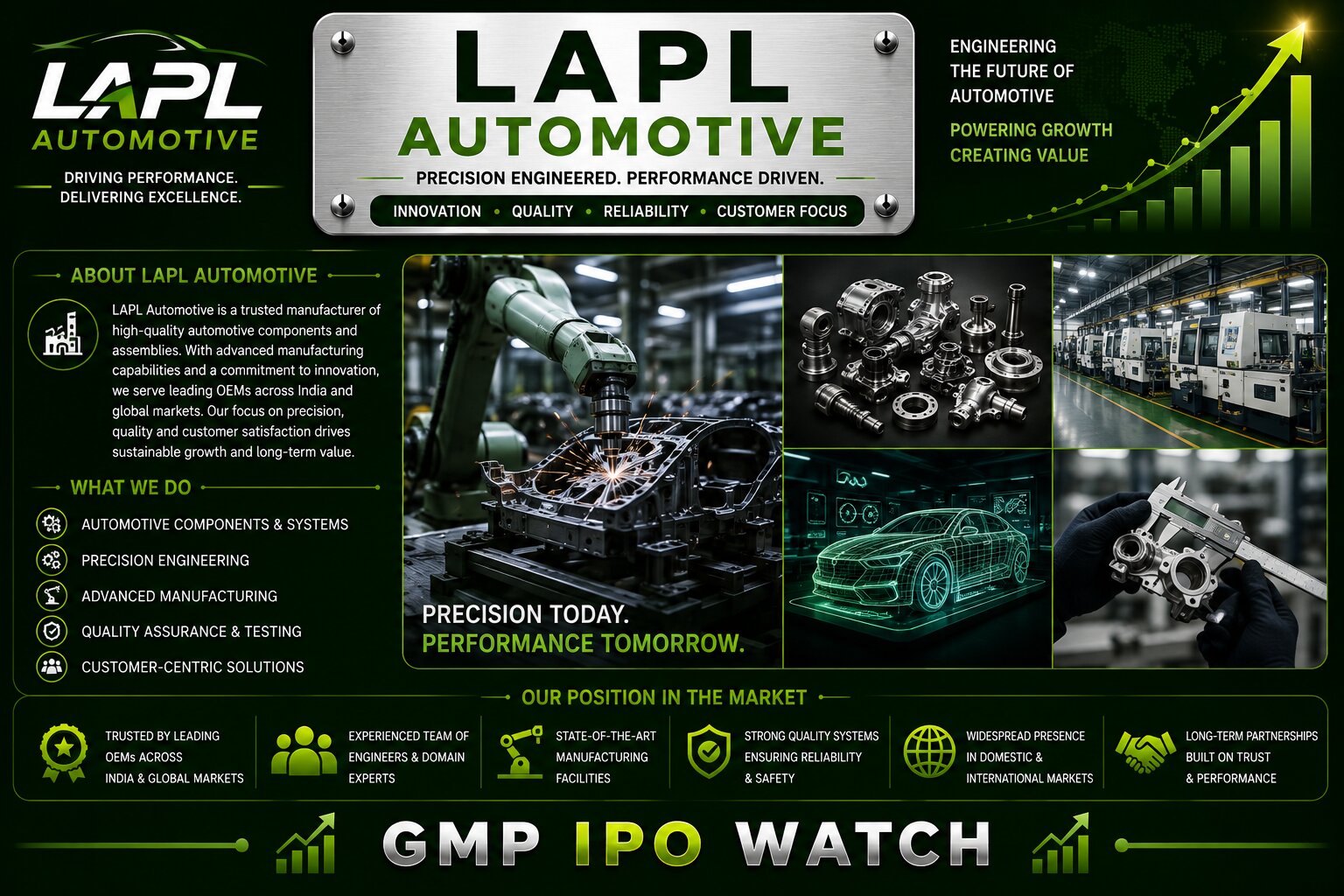
LAPL Automotive Limited operates in this specialised segment by manufacturing automotive lighting products and plastic automotive components for OEMs and the replacement market. The company has built its business around headlamps, tail lamps, signal lamps and various vehicle lighting assemblies supplied to automobile manufacturers and aftermarket distributors.
The company is preparing to launch its BSE SME IPO, which is a fixed-price issue of ₹28.08 crore at ₹78 per equity share. The IPO consists entirely of a fresh issue of 36 lakh equity shares and aims to support future manufacturing expansion.
This article provides a fresh perspective on LAPL Automotive by focusing on its manufacturing process, automotive lighting opportunity, customer relationships, financial performance, IPO objectives, future growth opportunities, risks and investment outlook.
About LAPL Automotive Limited
LAPL Automotive is an automotive component manufacturer headquartered in Aurangabad, Maharashtra.
The company specialises in designing and manufacturing:
- Automotive headlamps
- Tail lamps
- Signal lamps
- Reflectors
- Plastic automotive components
- Exterior vehicle lighting systems
- Automotive accessories
Its products are supplied across multiple vehicle categories including passenger vehicles, commercial vehicles and two-wheelers.
According to the company, its journey began under the leadership of promoter Neeraj Goyal, who has long experience in India's automotive lighting industry and played a role in developing facelift tail lamps for the Ambassador vehicle before establishing LAPL Automotive.
Understanding the Automotive Lighting Industry
Vehicle lighting is much more than an aesthetic feature.
Every lighting component performs important functions related to:
- Driver visibility
- Road safety
- Vehicle signalling
- Night driving
- Weather conditions
- Regulatory compliance
Modern vehicles require multiple lighting systems including:
- Headlights
- Daytime running lamps
- Tail lamps
- Brake lamps
- Turn indicators
- Fog lamps
- Reverse lamps
- Interior lighting
With increasing demand for LED technology, manufacturers are also investing in more energy-efficient and durable lighting products.
How LAPL Automotive Generates Revenue
LAPL Automotive follows a manufacturing-based business model.
Its operations generally include:
- Product design
- Tool development
- Plastic moulding
- Injection moulding
- Component assembly
- Electrical fitting
- Quality inspection
- Packaging
- Delivery
Revenue is generated primarily from supplying finished products to OEM customers and aftermarket distributors.
Business performance depends upon:
- Vehicle production
- Customer orders
- New product development
- Manufacturing efficiency
- Raw material prices
- Quality performance
Manufacturing Process
Automotive lighting products require high manufacturing precision.
A typical production process includes:
Product Design
Customer specifications are converted into engineering drawings.
Tool Manufacturing
Precision moulds are developed for plastic injection moulding.
Injection Moulding
Plastic housings and components are manufactured.
Reflector Manufacturing
Reflective surfaces are prepared for optimum light distribution.
Assembly
Electrical parts, lenses, reflectors and housings are assembled.
Testing
Products undergo:
- Water leakage tests
- Vibration tests
- Electrical testing
- Brightness testing
- Dimensional inspection
- Quality checks
Only products meeting customer specifications are dispatched.
OEM Business Creates Long-Term Relationships
Unlike many consumer-product manufacturers, automotive suppliers generally work directly with vehicle manufacturers.
Once a supplier receives OEM approval, it may continue supplying components for the complete production cycle of that vehicle model.
This creates opportunities for:
- Repeat orders
- Stable revenue
- Product upgrades
- New model development
However, losing an OEM customer can significantly affect business performance.
Growth in LED Automotive Lighting
Automotive lighting technology has changed considerably during the past decade.
Manufacturers are increasingly shifting towards:
- LED headlamps
- LED tail lamps
- Energy-efficient lighting
- Smart lighting
- Daytime running lights
- Sequential indicators
LED systems offer:
- Lower power consumption
- Longer life
- Better brightness
- Improved styling
- Reduced maintenance
Companies capable of adapting to changing technologies may benefit from future vehicle launches.
LAPL Automotive IPO Details
| Particular | Details |
|---|---|
| IPO Type | SME Fixed Price IPO |
| Exchange | BSE SME |
| Issue Size | ₹28.08 Crore |
| Issue Price | ₹78 Per Share |
| Face Value | ₹10 |
| Fresh Issue | 36,00,000 Shares |
| Offer For Sale | Nil |
| Lot Size | 1,600 Shares |
| Minimum Investment | ₹1,24,800 |
The IPO consists entirely of a fresh issue, meaning the proceeds will be utilised by the company for business expansion rather than providing an exit to existing shareholders.
Objectives of the IPO
According to the draft offer documents, the company intends to utilise the IPO proceeds mainly for:
- Establishment of a new manufacturing facility
- Purchase of machinery
- Working capital
- General corporate purposes
Investment in manufacturing capacity is expected to improve production capability and support future customer orders.
Why Capacity Expansion Matters
Automotive component manufacturing depends heavily on production capacity.
Higher manufacturing capability can allow the company to:
- Accept larger OEM orders
- Increase production efficiency
- Reduce unit costs
- Manufacture new product categories
- Improve delivery timelines
Capacity expansion also supports future revenue growth without excessive outsourcing.
Financial Performance
LAPL Automotive has reported consistent improvement in business performance.
| Financial Year | Revenue | Profit After Tax |
| FY2024 | ₹48.77 Crore | ₹3.40 Crore |
| FY2026 (Annualised) | ₹82.35 Crore | ₹7.52 Crore |
The company has recorded significant improvement in revenue as well as profitability, indicating better operational performance and increasing customer demand.
Improving Profitability
Profit growth has outpaced revenue growth in recent financial periods.
Possible reasons include:
- Higher production
- Better capacity utilisation
- Improved product mix
- Operating leverage
- Better manufacturing efficiency
- Cost optimisation
Investors should continue monitoring whether these margins remain sustainable as production expands.
Working Capital Requirements
Automotive suppliers generally invest significant capital before receiving payments from customers.
Working capital is required for:
- Plastic granules
- Electronic components
- Packaging materials
- Inventory
- Employee costs
- Manufacturing
- Logistics
Additional working capital allows the company to fulfil larger customer orders without excessive dependence on short-term borrowings.
Industry Opportunity
India's automotive sector continues expanding because of:
- Rising passenger vehicle demand
- Commercial vehicle growth
- Electric vehicle adoption
- Export opportunities
- Increasing replacement demand
- Government manufacturing initiatives
Every new vehicle requires multiple lighting components, creating long-term demand for automotive lighting manufacturers.
Competitive Strengths
LAPL Automotive benefits from several important strengths:
- Automotive lighting specialisation
- OEM manufacturing experience
- Product design capability
- Manufacturing expertise
- Long promoter experience
- Customer relationships
- Planned capacity expansion
- Growing financial performance
These strengths provide a platform for future business growth.
Major Risk Factors
Investors should also evaluate key business risks.
Customer Concentration
Dependence on a limited number of OEM customers may affect revenue stability.
Automotive Industry Cycles
Vehicle production can fluctuate because of economic conditions.
Raw Material Prices
Plastic polymers, electronic components and metals are subject to price volatility.
Technology Changes
Rapid adoption of new lighting technologies requires continuous investment.
Working Capital
Manufacturing businesses require significant inventory and receivable funding.
Competition
The automotive component industry remains highly competitive with several established domestic and international suppliers.
Grey Market Premium
Unofficial market discussions before the IPO have indicated a positive Grey Market Premium of around ₹16, suggesting estimated listing interest near ₹94, although GMP remains unofficial and may change before listing. Investors should treat these figures only as market sentiment rather than guaranteed listing performance.
Although the automotive sector offers attractive long-term opportunities, investors should carefully analyse customer concentration, working-capital management, valuation and future order visibility before investing.
Overall, LAPL Automotive represents a manufacturing-focused SME IPO with steady growth potential, supported by India's expanding automobile industry, while carrying the normal execution and customer-dependence risks associated with automotive suppliers.